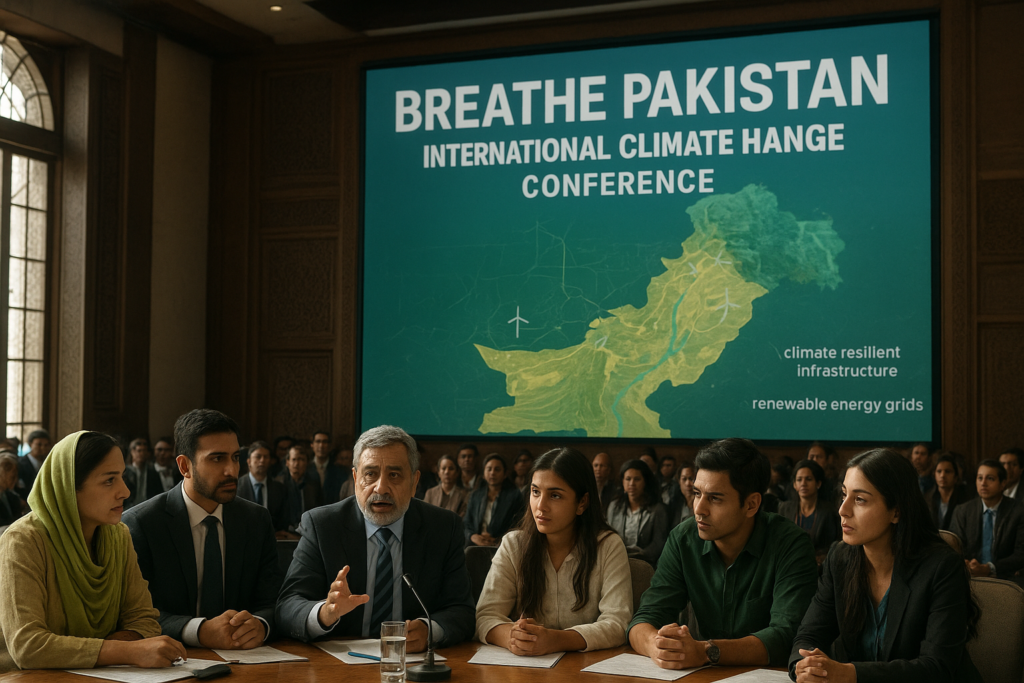

Musadik Malik emphasizes that dialogue alone cannot protect lives; tangible action is essential
The second edition of the Breathe Pakistan International Climate Change Conference is currently underway in Islamabad. Hosted at the Sheesh Mahal Hall of the Serena Hotel, the two‑day event gathers policymakers, climate experts, business leaders, and civil‑society representatives to confront Pakistan’s mounting climate challenges and to outline concrete solutions.
Pakistan contributes a small fraction of global greenhouse‑gas emissions, yet it ranks among the world’s most climate‑vulnerable countries. Frequent floods, severe heatwaves, and unpredictable weather patterns have intensified the urgency for coordinated, locally grounded, and globally informed responses. The conference aims to translate this urgency into actionable policies, financing mechanisms, and collaborative projects.
Key Themes and Objectives
– Climate justice and equitable financing: Participants will discuss how to secure international climate funds and ensure that resources reach the most affected communities.
– Adaptation and resilience: Sessions focus on practical measures to protect infrastructure, agriculture, and livelihoods from extreme weather events.
– Renewable energy transition: Experts will present pathways for scaling solar, wind, and hydro power to reduce reliance on fossil fuels.
– Community engagement: The agenda highlights the role of grassroots movements and local knowledge in shaping effective climate strategies.
Musadik Malik, a senior climate strategist, addressed the opening plenary, stating, “Conversation alone does not save people; something real has to happen.” He warned that Pakistan’s climate reality has worsened since the inaugural conference and called for immediate, measurable steps rather than continued rhetoric.
The first Breathe Pakistan conference sparked nationwide dialogue and attracted international partners, setting the stage for deeper collaboration on climate finance, technology transfer, and policy alignment. Building on that foundation, the current edition seeks to move from discussion to implementation, with a focus on:
– Mobilizing climate finance from multilateral institutions and private investors.
– Establishing a national framework for climate‑resilient infrastructure.
– Launching pilot projects that demonstrate low‑carbon technologies in rural and urban settings.
– Strengthening early warning systems and disaster‑risk management protocols.
Stakeholder Perspectives
Government officials emphasized the need for policy coherence across ministries, highlighting recent legislative drafts that aim to integrate climate considerations into development planning. Private‑sector representatives showcased innovative solutions, including solar micro‑grids for off‑grid communities and climate‑smart agricultural practices that conserve water while boosting yields.
Civil‑society groups called for transparent allocation of climate funds and greater inclusion of women and youth in decision‑making processes. Their advocacy underscores the belief that inclusive governance is critical to achieving long‑term climate resilience.
Outcomes Expected
The conference is slated to produce a set of actionable recommendations, a roadmap for scaling renewable energy projects, and a pledge framework for international donors. Organizers anticipate that the outcomes will feed directly into Pakistan’s Nationally Determined Contributions (NDCs) under the Paris Agreement, strengthening the country’s commitment to limiting global warming.
Looking Ahead
As the Breathe Pakistan International Climate Change Conference progresses, participants are urged to translate ideas into binding agreements and pilot initiatives that can be replicated nationwide. The event serves as a pivotal platform for aligning Pakistan’s climate agenda with global best practices while addressing the unique vulnerabilities of its population.
For continued coverage of the conference, follow PAK Pulse for updates on policy announcements, partnership deals, and on‑the‑ground stories from Islamabad. The collective hope is that this gathering will catalyze real change, ensuring a safer, more sustainable future for Pakistan and the broader South Asian region.