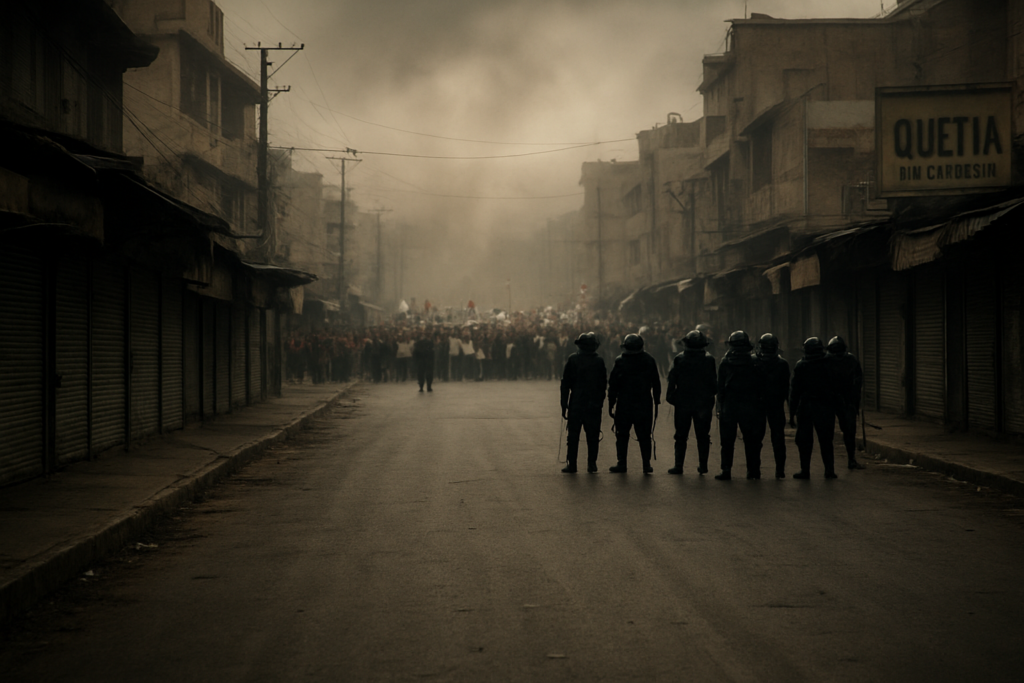

Quetta and several districts across Balochistan experienced a widespread shutdown on Saturday as residents staged a coordinated protest against recent security measures. The curfew‑like situation began early in the morning, with major thoroughfares, markets and public transport coming to a standstill. Local authorities reported that the disruption affected not only the provincial capital but also key towns such as Khuzdar, Turbat and Gwadar.
The protest was organized by a coalition of community groups, trade unions and student organisations demanding the release of detained activists and an end to what they described as excessive police raids. Demonstrators gathered at prominent city squares, chanting slogans and holding placards that called for justice, transparency and respect for civil liberties. In Quetta, the crowd grew to several thousand people before security forces intervened.
Police deployed additional personnel to contain the gathering and to enforce the shutdown. According to official statements, officers used non‑lethal crowd‑control methods to disperse the protesters after a series of negotiations failed to produce a peaceful resolution. Several arrests were made, and a few minor injuries were reported among both demonstrators and law‑enforcement personnel. No fatalities were confirmed.
Business owners across the province reported significant losses due to the abrupt closure of shops, restaurants and service outlets. Traders in the central market of Quetta described the day as “economically damaging,” noting that the shutdown lasted for more than eight hours. Transportation services, including intercity buses and private taxis, were forced to suspend operations, leaving commuters stranded and prompting complaints on social media platforms.
Local government officials emphasized that the shutdown was not sanctioned by the provincial administration. A spokesperson for the Balochistan chief minister’s office said the authorities were monitoring the situation closely and were prepared to engage with legitimate representatives of the community. The statement also warned that any illegal obstruction of public order would be dealt with according to the law.
Political analysts suggest that the protest reflects growing frustration over perceived marginalisation and a lack of dialogue between the government and civil society. Experts point to a series of recent arrests of journalists, activists and students as a catalyst for the heightened tension. The shutdown in Quetta and surrounding districts may signal an escalation of public dissent if grievances are not addressed through inclusive political channels.
The shutdown ended late in the evening as police gradually cleared the main streets and allowed limited movement. Authorities have announced that normal services will resume the following day, and a meeting between government representatives and community leaders is scheduled for early next week. Observers advise that continued monitoring of the security environment in Balochistan is essential, given the potential for further disruptions.
Keywords: Quetta shutdown, Balochistan protest, provincial curfew, police crackdown, civil unrest, market closures, transport disruption, political tension, community demands, security measures.